


How road signs near schools keep children safe
Signs and road signs near schools help keep children safe. They warn drivers that children may be crossing the road ahead, and they help keep speeds low at the busiest times of day, when children are arriving at school or going home. Road markings outside schools show where drivers must not stop, so that children can see and be seen when they cross. The traffic signs section of the Highway Code shows the main ones.
Some common signs near schools in the UK are:
- the School warning sign, which warns that children may be crossing the road on their way to or from school
- the School crossing patrol ahead sign, which tells you to be ready to stop for a school crossing patrol
- the circular Stop for children sign, held up by the school crossing patrol, which you must obey
- speed limit signs, such as the signs for a 20 mph zone
Near some schools you may also see signs for routes for cyclists and people walking.
Why road signs near schools matter
The roads near a school can be very busy at the start and end of the school day, with cars, cyclists, buses and people walking all sharing the road. Signs near schools remind drivers of the rules and point out where to take extra care, such as near crossings and bus stops. Children can be hard to see and may not be able to judge your speed. They may run into the road suddenly, for example to catch a bus, so take extra care.
Speed makes a big difference. The Highway Code says that at 40 mph your vehicle will probably kill any pedestrian it hits, but at 20 mph there is only a 1 in 20 chance of the pedestrian being killed (rule 207).
Many children are driven to school, and parking near the school gate can be a problem. Highway Code rule 243 says do not stop or park near a school entrance.
School entrance markings
Outside many schools there are yellow zig-zag lines with the words School Keep Clear. They mark the length of road where you should not stop, not even to pick up or set down children. If there is also an upright sign, stopping there during the times shown is against the law (rule 238). The markings are there so that children can see and be seen clearly when they cross the road.
Who sets the speed limits near schools
Local councils can set their own speed limits in some areas, for example a 20 mph zone in a built-up area near a school, and these must be clearly signed (GOV.UK speed limits). The signs are placed near crossing points, playgrounds, bus stops and cycle routes, where drivers can see them in good time.
Types of road sign near schools
Speed limits, warnings and crossings
Signs near schools give orders, warn and inform, to help drivers keep children safe on their way to and from school.
One example is the speed limit sign. Many roads near schools have a 20 mph limit or a 20 mph zone. In Wales, the default limit on restricted roads, which are usually residential roads with street lights, has been 20 mph since September 2023. Some roads near schools have a part-time advisory 20 mph sign. It is advice that applies at certain times, not a legal limit, but you should follow it.
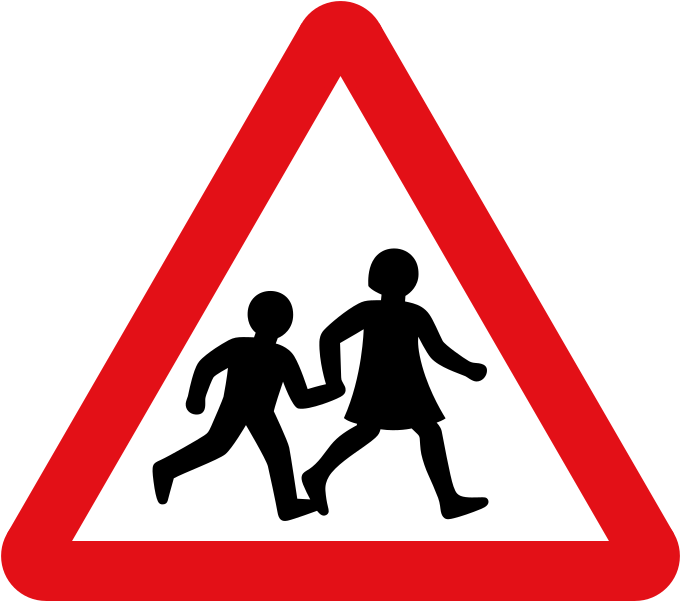
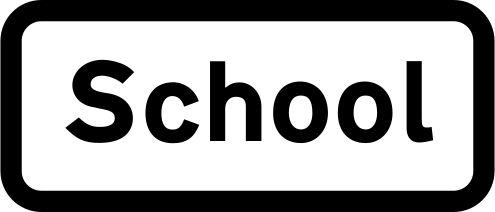
Warning signs near schools are just as important. The School warning sign is a red triangle showing 2 children, with a plate below that says School. It warns that children may be crossing the road on their way to or from school. In some places there is a flashing amber signal below the sign, which tells you that children may be crossing the road ahead (rule 208).
There are also safe places for children to cross, such as zebra and other pedestrian crossings, and places where a school crossing patrol helps them across. Some schools have cycle routes, or routes shared by cyclists and people walking, so look out for young cyclists.
Flashing lights near schools
Flashing amber lights are an extra warning. Some School signs have flashing amber lights below them, and some School crossing patrol ahead signs have amber lights that flash when the crossing is in use. When the lights are flashing, children may be crossing. Slow down and drive very slowly until you are clear of the area (rule 208).
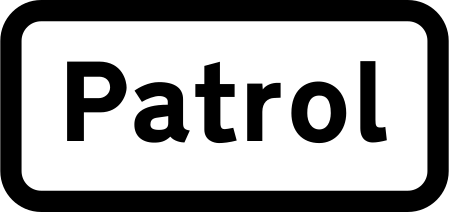
As well as signs and lights, school crossing patrols, often called lollipop men and women, help children cross the road on their way to and from school. The School crossing patrol ahead sign is the same red triangle with a plate below that says Patrol.
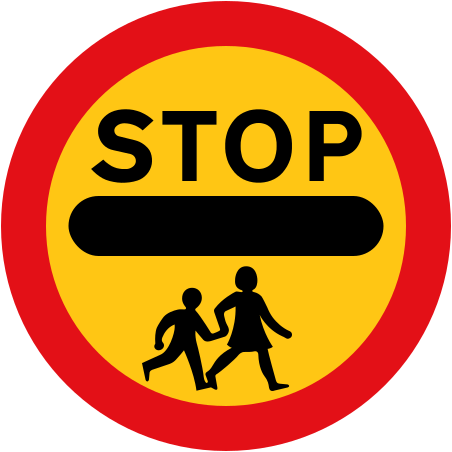
The patrol stands in the road and holds up a circular Stop for children sign. You MUST stop when a school crossing patrol shows this sign (rule 210), and you must not go beyond it. Failing to stop is an offence that carries 3 penalty points (code TS60). Do not overtake as you approach a school crossing patrol (rule 167).
7 steps, 0:29 Flashing school lights and the school crossing patrol
Step 1 of 7 Flashing lights near schools.
Step 2 of 7 When the lights flash, children may be crossing.
Step 3 of 7 Slow down and drive very slowly.
Step 4 of 7 You must stop when the patrol shows the Stop for children sign.
Step 5 of 7 Wait while the patrol shows the sign.
Step 6 of 7 Then drive very slowly until you are clear of the area.
Step 7 of 7 Drive very slowly. You must stop when the sign is up.
Not loaded Check the connection, then press Try again.
How school signs look
Shapes and colours
Like all traffic signs, the signs near schools follow set shapes and colours, so you can tell what kind of sign it is at a glance:
- Triangles with a red border warn of a hazard ahead, such as children crossing.
- Circles give orders. Signs with red circles mostly tell you what you must not do. Blue circles with no red border mostly tell you what you must do.
- Rectangles give information. Direction signs are mostly rectangles: blue on motorways, green on primary routes, and white with a black border on other routes.
- The Stop sign is an octagon, a red sign with 8 sides.
The Stop for children sign is a circle, because it gives an order. It has a red border and a yellow centre.
Safety for drivers and children
How drivers should respond to school signs
All drivers, including learners, need to know the Highway Code. It sets out the rules of the road for England, Scotland and Wales. For schools, study rules 208, 209 and 210, which tell you what to do near schools.
In short:
- Near a school, drive slowly and look out for young cyclists and children walking. Watch for children who may move suddenly.
- You MUST NOT go over the speed limit, and you MUST stop when a school crossing patrol shows a Stop for children sign, even if you cannot see children waiting to cross.
- School buses show a School Bus sign in the front and rear windows. You do not have to stop for one, but drive carefully and slowly past a school bus that has stopped, because children may be getting on or off (rule 209).
- Do not stop or park on the yellow zig-zag lines outside a school, or near a school entrance.
Teaching children about road safety
There are many chances during the day to teach children about road safety. Children should learn the Green Cross Code (rule 7), and should not be out alone until they can understand and use it properly. The Code says:
- First find a safe place to cross. If there is a crossing nearby, use it.
- Stop just before you get to the kerb, where you can see if anything is coming. Do not get too close to the traffic.
- Look all around for traffic, and listen.
- If traffic is coming, let it pass. Look all around again and listen. Do not cross until there is a safe gap and you are sure there is plenty of time.
- When it is safe, go straight across the road. Do not run. Keep looking and listening while you cross.
At a school crossing patrol, children should only cross when the patrol signals, and should cross in front of them. Young children should not be out alone on the pavement or road. When you take them out, keep between them and the traffic and hold their hands firmly (rule 4). Children learn by example, so follow the Code yourself.
The role of road signs in school safety
Signs, road markings and speed limits near schools help keep children safe. They warn drivers to take extra care, show where children cross, and keep the area outside the school gate clear. They also help children, parents and staff find safe places to cross the road and safe routes to walk or cycle home.
The aim is to keep speeds low and children safe at the busiest times of day. When drivers slow down, watch out for children and obey school crossing patrols, the roads near schools are safer for everyone.
Sign pictures: drawings of the official UK traffic signs from Wikimedia Commons, containing public sector information licensed under the Open Government Licence v1.0.


