


Why road warning signs matter
Warning signs are part of the system of road signs in the Highway Code, the official guide to the rules of the road for everyone, from drivers to people walking. The Highway Code groups traffic signs into signs giving orders, warning signs, direction signs, information signs and road works signs.
What warning signs are
A warning sign tells you about a hazard or a change in the road ahead. The government booklet Know your traffic signs shows them all. They warn of things such as:
- bends, junctions and roundabouts
- the road getting narrower, or a dual carriageway ending
- steep hills, slippery roads, ice and side winds
- people likely to be crossing, such as children near a school or frail older people
- animals, from cattle and horses to deer and wild fowl
- traffic lights ahead, or traffic lights that are not in use
Why they are important for drivers
Warning signs give you advance notice of a problem you may not be able to see yet. That gives you time to check your mirrors, slow down and choose a safe position, instead of having to brake hard when you reach the hazard. Drivers who act on warning signs are less likely to be in a collision.
Types of warning sign
General warning signs
Most warning signs are permanent, because the hazard is always there, such as a bend, a steep hill or a hump bridge. Hazards that last a short time, such as road works, have their own road works signs. A plate below a warning sign can add detail, such as the distance to the hazard or how far it goes on.
Animal warning signs
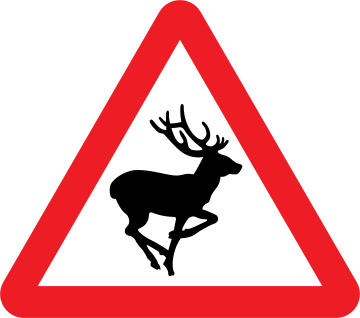
Animal warning signs show the animal you may meet: for example cattle, sheep, wild horses or ponies, deer, migrating toads or wild fowl. You will see them on country roads all over the UK. Slow down, be ready to stop, and look out for animals in or near the road. When you see a horse on the road, slow down to 10 mph or less, and when it is safe, pass wide and slowly, leaving at least 2 metres (rule 215).
Road conditions and hazards
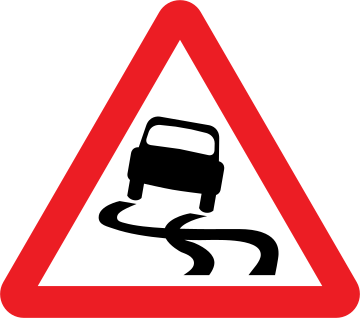
Snow, heavy rain and strong wind can make roads slippery and make it harder to see. Warning signs for these hazards include risk of ice, side winds and slippery road, which shows a car skidding. Take extra care with these signs when you know bad weather is coming.
Other warning signs tell you about falling rocks, low-flying aircraft, a hidden dip or a sharp bend. Slow down before you reach the hazard, not while you are in it.
How to recognise warning signs
Shapes and colours of warning signs
Almost all warning signs are triangles with a red border and a simple black picture on a white background. The picture shows the hazard: for example, a bumpy line for an uneven road, or a tram for trams crossing ahead.
A few warning signs look different:
- The sign that gives the distance to a Give Way line is a triangle that points down, like the Give Way sign, with a plate below showing the distance, such as 50 yds. Be ready to give way to traffic on the main road.
- Some warnings are words in a triangle instead of a picture, such as Ford.
- Some warnings are not triangles at all, such as the black and white chevrons on a sharp bend.
Common warning signs on UK roads
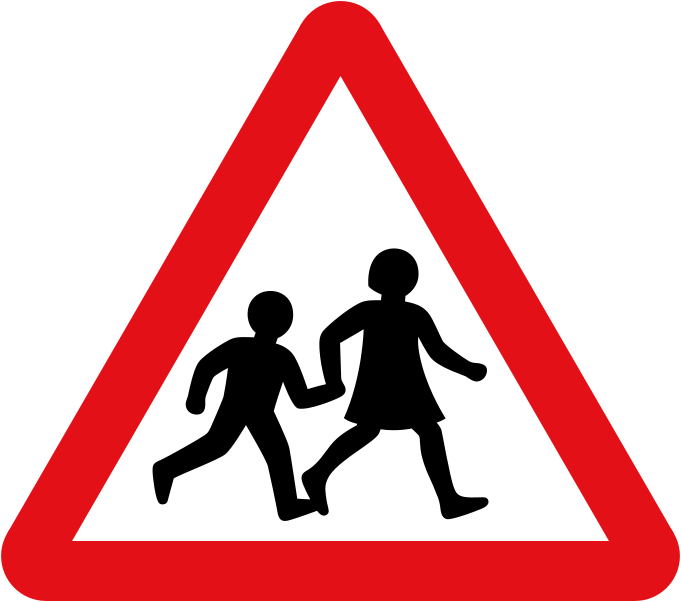
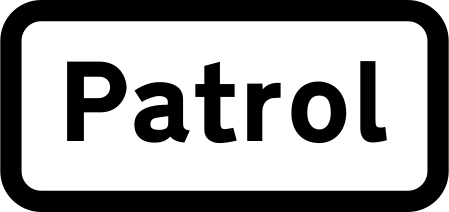
The school crossing patrol ahead sign is a red triangle showing 2 children, with a plate below that says Patrol. Some have amber lights that flash when the crossing is in use. Slow down, do not overtake as you approach (rule 167), and be ready to stop. You MUST stop when the patrol holds up the circular Stop for children sign (rule 210). The same triangle with a plate that says School warns that children may be crossing on their way to or from school.
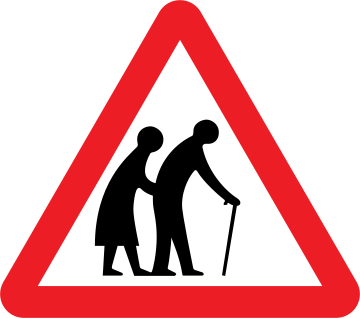
The frail pedestrians sign shows 2 older people, one with a walking stick. It warns that frail, older or disabled people are likely to cross the road ahead. They may need more time to cross, so be patient and do not hurry them (rule 207).
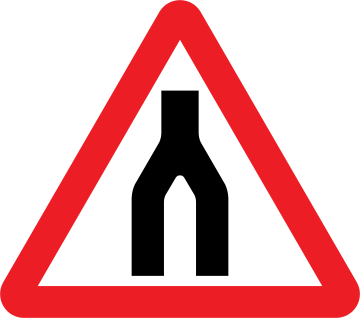
The dual carriageway ends sign warns that the central reservation is about to end. After it, traffic in both directions shares one road, so get into the left lane in good time and expect oncoming traffic. The two-way traffic sign gives a similar warning where a one-way stretch of road ends. These signs keep you alert to changes in the road layout.
Common situations with warning signs
What to do when you see a warning sign
You will see warning signs on almost every journey, so stay calm. Check your mirrors, slow down to a speed at which you could stop if you needed to, and look for the hazard the sign shows. Rule 146 asks you to adapt your driving to the road and to be ready for the unexpected. If a sign gives an order, such as a Stop sign, you must obey it.
Warning signs that people misread
Some warning signs are often misunderstood.
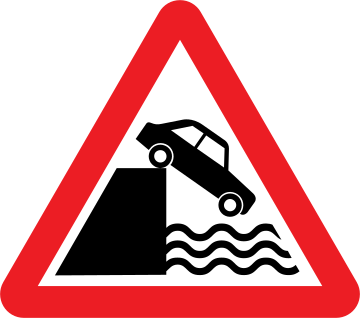
The quayside or river bank sign shows a car falling off the edge of a quay into water. It warns that the road runs along a quayside or river bank, where a vehicle could go into the water. Slow down, keep well away from the edge and take extra care in the dark or in fog.
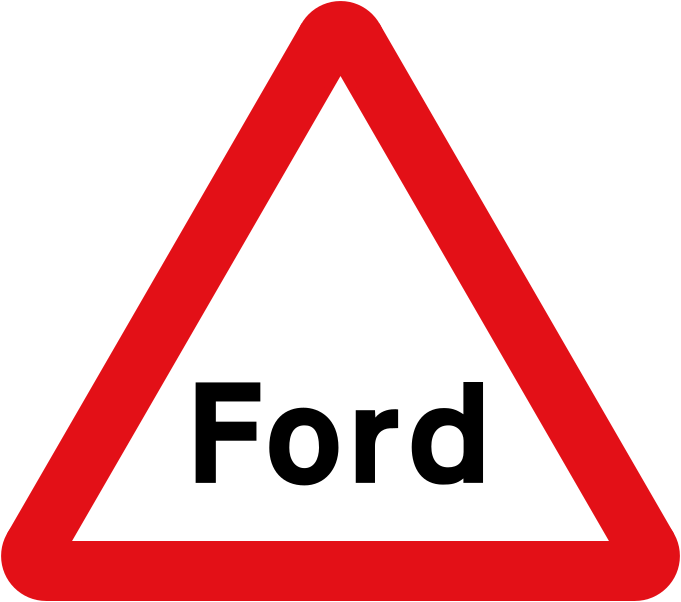
The Ford sign has the word Ford instead of a picture, which may be why some drivers misread it. It warns that water flows across the road ahead. Go slowly, take more care after heavy rain, and after driving through deep water test your brakes as soon as it is safe, because wet brakes work less well (rule 121). The same worded sign can say Flood, Gate or Gates instead.
Ignoring a warning sign puts you and others in danger. Most warning signs do not give an order, but if you ignore the hazard and drive without due care, you can be prosecuted for careless driving, which carries 3 to 9 penalty points. If you get 12 or more penalty points within 3 years, you can be banned from driving.
Tips for passing the theory test
How warning signs feature in the tests
To get a full licence you pass the theory test first, then the practical driving test. The theory test is taken on a computer, not on paper, and has 2 parts, which you must both pass:
- 50 multiple-choice questions in 57 minutes
- a hazard perception test with 14 video clips, where you score points by clicking as soon as you see a hazard developing
The multiple-choice questions are based on 3 official books, including the Highway Code and Know your traffic signs, so expect questions about traffic signs. Learn to recognise each warning sign by its shape, colour and picture. In the practical test, the examiner watches how you respond to signs and hazards as you drive.
Common questions about warning signs in the theory test
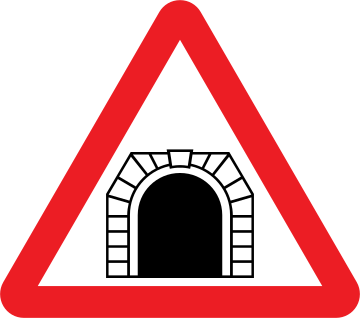
A question may show you a picture of a warning sign and ask what it means, choosing from several answers. It may also work the other way: you read what a sign means and choose the right picture. You could also be asked where you would see a sign: for example, the tunnel sign before the entrance to a tunnel.
Why drivers must pay attention to warning signs
Warning signs help keep everyone safe, including drivers, passengers, people walking, cyclists and horse riders. They give you time to slow down and get ready, which cuts the risk of anything from a minor bump to a fatal crash.
Signs that give orders, mostly circles, are the law, and you MUST obey them (Highway Code rule 109). Warning triangles are mostly advice, but a court can use the Highway Code as evidence when it decides who was to blame for a crash, and driving without due care is an offence.
Sign pictures: drawings of the official UK traffic signs from Wikimedia Commons. Some are in the public domain. The others contain public sector information licensed under the Open Government Licence v1.0.


